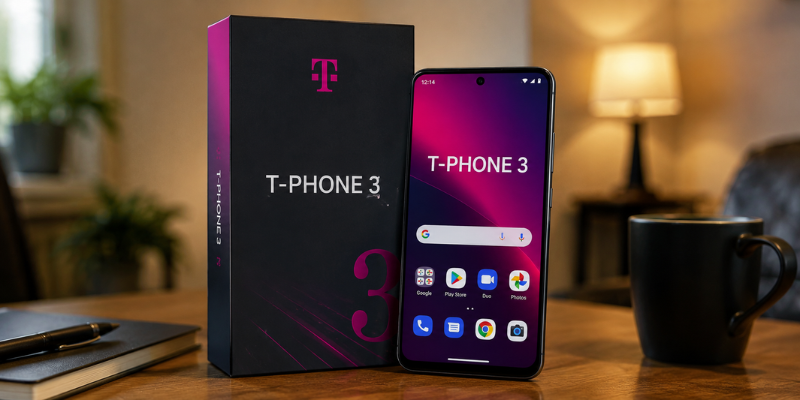

Smartphones no longer compete only on camera megapixels or processor speed. AI has quickly become one of the biggest selling points, and the T Phone 3 is one of the more interesting attempts to bring that experience to a more affordable phone.
Instead of trying to compete directly with expensive flagship devices, the T Phone 3 focuses on useful everyday features, including an integrated AI assistant, a 120Hz display, a 50MP camera system, and a large 5,000mAh battery.
But specifications alone do not tell the whole story. The more important question is whether these features actually make the phone better to use every day. Let’s take a closer look.
A Budget Phone With a Clear Purpose
The T Phone 3 comes from Deutsche Telekom’s smartphone lineup and is positioned as an affordable device with a strong emphasis on artificial intelligence.
That positioning is important because the phone isn’t trying to be a luxury handset. Instead, it targets people who want a modern Android experience without paying flagship prices.
The combination is practical: a capable Snapdragon processor, plenty of battery capacity, a smooth 120Hz screen, expandable storage, and built-in AI tools. Telekom lists 6GB of RAM and 128GB of internal storage, with support for microSD cards up to 2TB.
For someone replacing an older entry-level smartphone, that package makes considerably more sense than chasing individual headline specifications.
Display and Everyday Viewing
One of the first things users notice about a phone is its display, and the T Phone 3 makes a strong case for itself here.
It features a 6.6-inch Full HD+ display with a 120Hz refresh rate. The higher refresh rate makes scrolling through websites, social media feeds, and menus feel noticeably smoother than traditional 60Hz screens.
This matters more than it might initially sound.
Imagine checking emails during a commute, browsing an online store, or scrolling through a long article. A smoother screen makes those small interactions feel more fluid. It does not transform the phone into a flagship, but it can make the overall experience feel more expensive than the price suggests.
The large screen is also useful for video streaming and casual gaming. However, buyers who specifically want a premium AMOLED experience should look at higher-end alternatives, including the T Phone 3 Pro, which uses a 6.8-inch AMOLED Full HD+ 120Hz display.
Performance for Daily Tasks
Under the hood, the T Phone 3 uses Qualcomm’s Snapdragon 6 Gen 3 processor.
This is a sensible choice for a mid-range smartphone. It is designed to handle everyday activities such as messaging, web browsing, video streaming, navigation, social media, and ordinary multitasking without requiring flagship-level hardware.
The processor has an octa-core configuration, with four performance cores reaching up to 2.4GHz and four efficiency-focused cores running at up to 1.8GHz.
In practical terms, this means the T Phone 3 is better suited to everyday productivity than demanding gaming.
If your typical day includes WhatsApp, YouTube, Google Maps, Spotify, Chrome, email, and photography, the hardware should be a comfortable match. Heavy gamers, however, may want a more powerful device with stronger graphics performance.
That distinction is worth remembering: a phone doesn’t need to be the fastest available to be a good phone.
AI Features Are the Main Attraction
The most distinctive part of the T Phone 3 is its AI integration.
The phone includes the Perplexity Assistant, which can be accessed through the dedicated Magenta button and is designed to help with everyday tasks. Telekom also includes 18 months of Perplexity Pro with the device.
Think of situations where you normally jump between several apps.
You might ask an AI assistant to help plan a trip, summarize information, translate something, suggest ideas, or help write text. The appeal of the T Phone 3 is that these capabilities are placed closer to the normal smartphone experience.
There is also an interesting practical benefit for less technical users. Someone who has never spent much time experimenting with standalone AI applications may find it easier to start when an assistant is already integrated into the phone.
That said, the AI isn’t a reason to assume the phone itself possesses unlimited on-device intelligence. Much of the underlying AI experience comes through cloud-based services rather than specialized local AI hardware.
That distinction is important when comparing the T Phone 3 with more expensive AI-focused smartphones.
Camera: More Than Just a Big Number
The T Phone 3 features a 50MP dual-camera system with optical image stabilization.
A 50MP specification sounds impressive, but megapixels alone don’t determine whether a camera takes good photographs. Processing, stabilization, lighting, lenses, and software all play important roles.
Optical image stabilization is particularly useful for everyday photography because it can help reduce blur caused by small hand movements. It can also be useful when recording video or taking photographs in less-than-perfect lighting.
The phone also includes Picsart camera AI tools, adding software-based editing capabilities to the photography experience. Telekom currently includes three months of Picsart Pro with the T Phone 3.
For casual photographers, this combination should be more useful than simply chasing a huge megapixel count.
If you’re photographing family gatherings, meals, pets, travel scenes, or quick social-media content, having stabilization and easy editing tools can make a bigger difference than a specification sheet suggests.
Battery Life and Charging
Battery life is another area where the T Phone 3 takes a practical approach.
The phone has a 5,000mAh battery and supports 25W fast charging.
A battery of this size is reassuring for people who don’t want to constantly search for a charger. Actual endurance will naturally depend on screen brightness, mobile network conditions, gaming, camera usage, and other factors.
For a typical user who spends the day messaging, browsing, streaming occasionally, taking photographs, and using navigation, the large battery should provide a comfortable foundation.
The 25W charging isn’t the fastest technology on the market, but it is a reasonable match for a phone in this category. Users who prioritize extremely rapid charging may find premium competitors more appealing.
Still, there is something to be said for consistency. A phone that lasts comfortably through a normal day can be more useful than one with spectacular charging speeds but aggressive battery consumption.
Storage, Connectivity and Practical Extras
The T Phone 3 offers 128GB of internal storage and supports microSD expansion of up to 2TB.
That expandable storage is a particularly useful feature for people who keep lots of photographs, videos, music, or offline documents.
The phone also supports both Nano-SIM and eSIM, along with NFC for compatible contactless functions. It includes USB-C connectivity, Bluetooth, Wi-Fi, GPS, and a 3.5mm headphone jack.
The headphone jack is easy to overlook because it has disappeared from many modern smartphones. For users who already own wired headphones, however, it can eliminate the need for an adapter.
The device also carries an IP54 rating, providing protection against dust and water splashes. It should not be confused with a fully waterproof phone, but the added protection is useful for everyday accidents.
Who Should Consider the T Phone 3?
The T Phone 3 makes the most sense for a specific type of buyer.
It is particularly appealing if you want:
- A smooth 120Hz smartphone display
- A large 5,000mAh battery
- Useful AI tools without buying a flagship
- Expandable storage through microSD
- A 3.5mm headphone jack
- 5G connectivity
- A capable Snapdragon mid-range processor
- A stabilized 50MP camera
- A relatively straightforward Android experience
It is less compelling for people who demand top-tier gaming performance, flagship photography, ultra-fast charging, or premium materials.
That is not necessarily a weakness. The smartest way to judge an affordable smartphone is to ask whether it gets the important things right for its intended audience.
T Phone 3 vs T Phone 3 Pro
The T Phone 3 Pro is the obvious comparison.
The Pro model steps things up with a larger 6.8-inch AMOLED display, a 50MP triple-camera system with optical image stabilization, and 33W charging. It also uses the Snapdragon 6 Gen 3 processor and a 5,000mAh battery.
This creates a simple decision.
If you want the more affordable option and mainly care about everyday performance, battery life, AI features, and practical functionality, the standard T Phone 3 is the more sensible choice.
If display quality, camera flexibility, and faster charging matter more, the T Phone 3 Pro deserves the extra attention.
The interesting point is that both devices follow the same broader philosophy: make AI more accessible without forcing buyers into flagship pricing.
Frequently Asked Questions
Is the T Phone 3 a good smartphone?
Yes, particularly for users looking for a balanced mid-range phone. Its 120Hz display, Snapdragon 6 Gen 3 processor, 5,000mAh battery, 50MP stabilized camera, expandable storage, and integrated AI features create a well-rounded package.
What processor does the T Phone 3 use?
The T Phone 3 uses Qualcomm’s Snapdragon 6 Gen 3 processor. It is aimed at mid-range performance and is suitable for everyday apps, streaming, browsing, communication, navigation, and casual gaming.
Does the T Phone 3 have AI features?
Yes. The phone integrates the Perplexity Assistant and includes 18 months of Perplexity Pro under Telekom’s current offer. It can assist with tasks such as answering questions, planning, writing, and other everyday activities.
How much battery does the T Phone 3 have?
The T Phone 3 has a 5,000mAh battery and supports 25W fast charging. This capacity is well suited to users who want dependable battery life throughout a normal day.
Is the T Phone 3 good for gaming?
It can handle casual and moderately demanding mobile games, but it is not designed as a dedicated gaming phone. The Snapdragon 6 Gen 3 is a mid-range processor, so serious gamers should consider devices with more powerful chipsets and stronger graphics hardware.
Conclusion
The T Phone 3 takes a refreshingly practical approach to the smartphone market. Instead of chasing every flagship specification, it focuses on features people can actually use: a smooth 120Hz display, capable performance, strong battery capacity, expandable storage, stabilized photography, and accessible AI tools.